SACOST-UEW Takes Chemistry to Ekumfi with Hands-On Festival for JHS Pupils


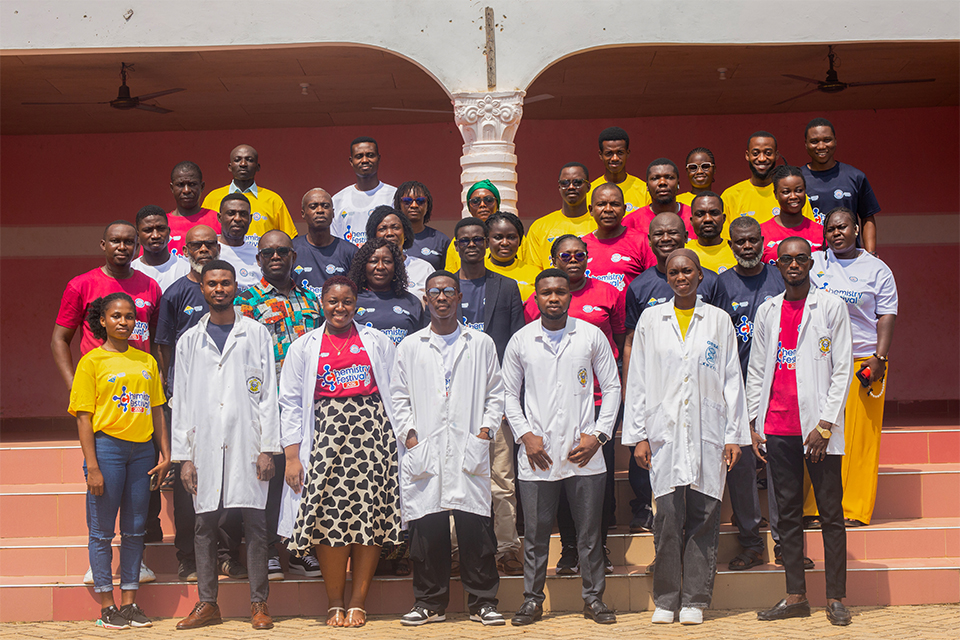
The Centre for School and Community Science and Technology Studies (SACOST) at the University of Education, Winneba (UEW), on Tuesday, 2nd December 2025, held a community-based Chemistry Festival at the Essakyir Community Centre for 90 Junior High School (JHS) pupils in the Ekumfi District.
The outreach activity, which also brought together nine teachers and staff of the Ekumfi District Directorate of the Ghana Education Service (GES), engaged learners from Essakyir Methodist Basic School, Ekumfi Ekrawfo T.I. Ahmadiyya Basic School and Esuehyia D.A. JHS.
The festival centred on exploring the chemistry of plant-based fabric dyes and introduced pupils to practical scientific concepts drawn from everyday life.

Dr. Ethel Addae, co-project lead, explained that the initiative sought to revive indigenous knowledge of natural dyes and demonstrate chemistry as a living science deeply linked to culture, environment and creativity. She emphasised that simple household items and common plants hold rich chemical properties that can be transformed into useful products.
“Chemistry is not far away in a laboratory; it is in our kitchens, our plants, our traditions and in the hands of every young person gathered here,” she stated as she encouraged pupils to experiment, ask questions and replicate the demonstrations in their schools.

Prof. Peter Akayuure, Chairman for the event and Head of SACOST, commended the project leads for championing a practical, community-centred approach to science education. He underscored chemistry’s important role in developing 21st-century skills such as creativity, critical thinking and problem solving, stressing that learners must understand the relevance of scientific concepts to their communities.
Prof. Akayuure urged pupils to value sustainable practices by opting for organic dyes such as turmeric and hibiscus instead of inorganic substances that harm the environment. He reminded teachers to contextualise lessons to make science relatable and meaningful. He advised, "When learning chemistry, always ask how it can help you and your community now and in the future."

Prof. Enoch F. Sam, Director of the Directorate of Research, Innovation and Development (DRID), likened the festival to a celebration of life, noting that chemistry forms the basis of many daily processes. He encouraged pupils to cultivate curiosity and continuous learning, saying that the programme provided an opportunity to rediscover indigenous science and explore how local resources can support community development.
Ms. Kafui Mary Ahlijah, Director of Education for the Ekumfi District, expressed gratitude to UEW for extending high-level scientific training to basic school learners. She urged pupils to approach chemistry with confidence and curiosity, emphasising that the discipline is embedded in everyday activities, from brushing one’s teeth to cooking. She expressed optimism that the hands-on experience would inspire future scientists, innovators and teachers from the district.

Participants were taken through a series of engaging practical sessions led by the demonstration team from the UEW. Using turmeric and hibiscus extracts, facilitators demonstrated acid-base reactions and guided pupils to test the plant dyes as natural indicators. Through paper chromatography, learners discovered that turmeric contains a single group of yellow compounds called curcuminoids while hibiscus revealed two distinct dye-bearing compounds responsible for its blue-black and wine-red colours.
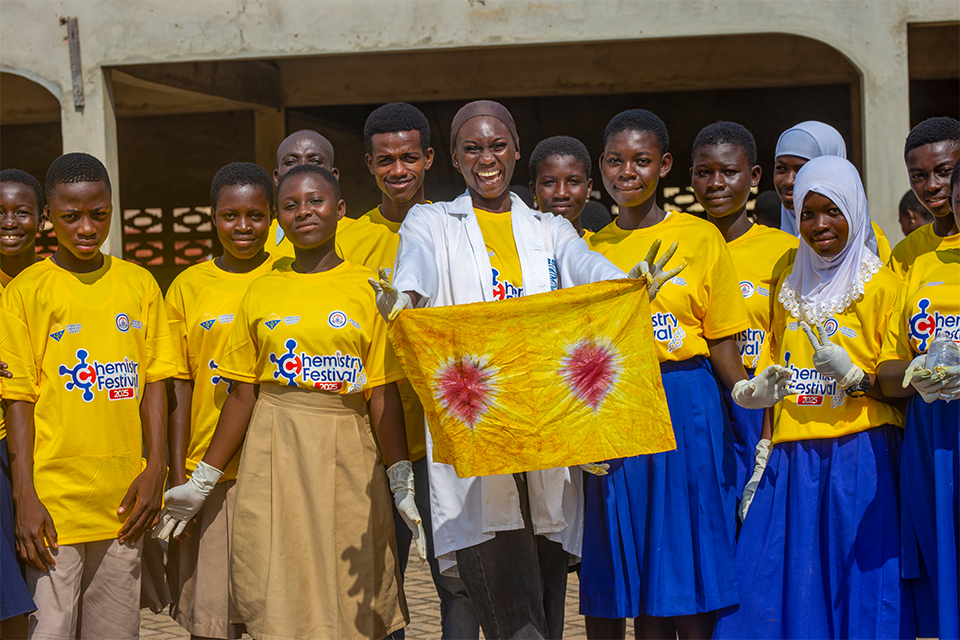
Pupils later learned fabric-dyeing techniques including mordanting—an essential process for fixing colours on fabric and experimented with folding patterns to produce unique tie-and-dye designs using the plant-based dyes.
The hands-on activities generated excitement among pupils and teachers who expressed appreciation for the opportunity to learn sustainable and culturally relevant science. According to the facilitators, the festival reinforced the value of using local resources in promoting environmentally friendly practices and deepening understanding of basic scientific principles.
The Chemistry Festival formed part of SACOST’s community outreach efforts to support practical science teaching and promote indigenous knowledge systems in line with UEW’s commitment to “Knowledge for Service.” Organisers expressed hope that the participating pupils would serve as ambassadors by sharing the skills and insights gained with their peers and communities.