
UEW Unveils Ebenezer Mensah’s Cultural Card Game Project


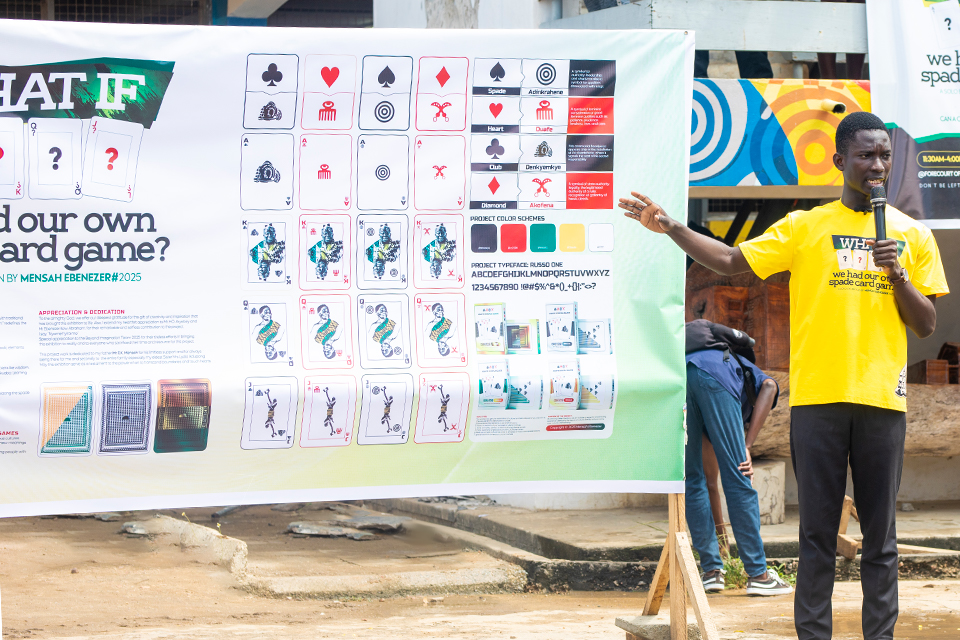
The Department of Art Education at the University of Education, Winneba (UEW), on Tuesday, 16th September, 2025, witnessed a significant moment in student creativity and cultural innovation when it formally unveiled “What if We Had Our Own Spade Card Game,” an inventive project by final-year student, Ebenezer Mensah.
Held at the forecourt of the Department, the exhibition drew lecturers, students, art enthusiasts and members of the public eager to see how a familiar Western pastime could be transformed into a powerful vehicle for Ghanaian cultural education.
At the centre of the showcase was Mensah’s project, “A Cultural and Graphical Exploration,” which reimagines the popular Spades card game by replacing its standard Western suits with traditional Akan Adinkra symbols. The new deck turns the game into a medium for cultural preservation, sparking conversations about Ghanaian heritage while encouraging positive traits such as patience and resilience among players.

“This is my end-of-year project work; it answers so many questions about our culture and our games. We have numerous traditional games like Ampe and Oware but most are purely for entertainment. I wanted to create a game that also preserves history and teaches values,” Mensah told guests.
Mensah explained that his substitutions were guided by symbolism rather than mere aesthetics. In the redesigned deck, the spade suit, traditionally the highest-ranking in the game, is replaced with the Adinkrahene, emblem of leadership and authority; hearts are represented by the Duafe, which stands for feminine virtues and care; clubs are exchanged for the Denkyemkye, the ceremonial headpiece signalling the Asantehene’s sacred responsibilities and diamonds become the Akofena, crossed swords symbolising valour and the defence of tradition.
Even the face cards have been localised: the Ace signifies Asanteman, the King and Queen retain their royal associations and the Joker is replaced by Okomfo Anokye, reflecting the legendary priest’s problem-solving ability and historic role in Asante statecraft.
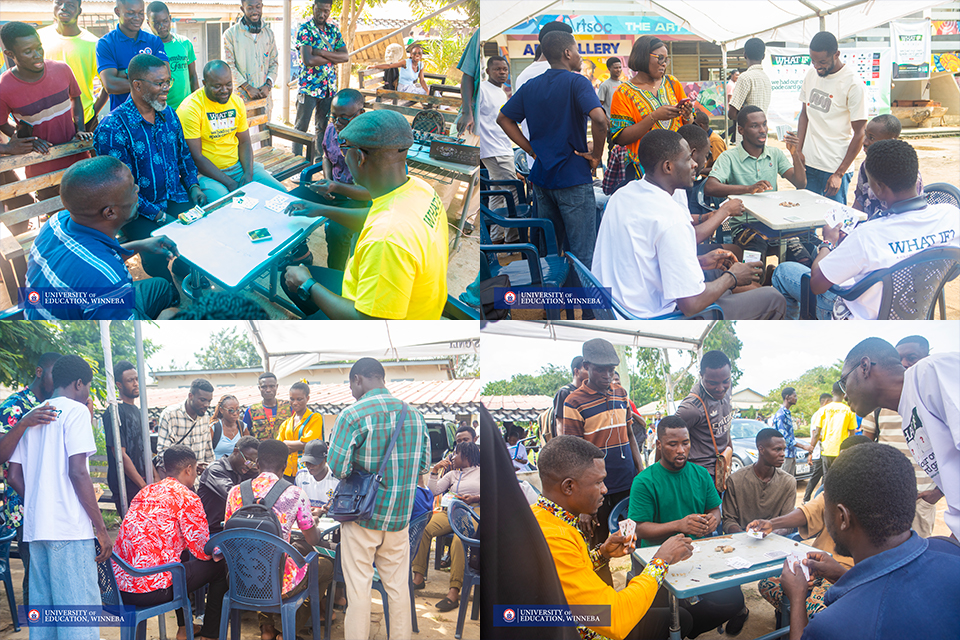
Mensah formed a “Beyond Imagination Team” of lecturers and colleagues to bring the project to life. He traced the history of Spades back to its European roots and its later popularity among soldiers during the Second World War, contrasting this with the difficulty of tracing ownership of most African traditional games.
“If questions are being asked since it is my own project, I will be able to defend it,” he said, noting that his focus on Asante symbols came from a need for depth and authenticity. Importantly, while the symbolism has changed, the rules of Spades remain intact, making the game instantly playable.

The unveiling attracted praise from across the University community. Mr. Henry O. Aryeetey, supervisor of the project, described the exhibition as more than a showcase of design skills. “It is a reflection of Ebenezer Mensah’s creative journey, personal growth and experimentation with visual storytelling. Graphic design is about communication, impact and intention. Through this exhibition, the artist has captured all three. This is a proud moment not just for Ebenezer but for all of us who have seen his talent grow and flourish,” he said.

Prof. Patrique deGraft-Yankson, Director of the Centre for Research in Culture and Creative Arts (CeRCCA), called the work a timely and necessary intervention. “We are at a point in history where we must look back at what we had, what we lost during colonisation and how to bring it back into our educational system. Almost everything in graphic design has been done by the Western world. What has not been explored and what the world wants to learn is what we have. This initiative unearths our culture and contributes to global knowledge. For me, this qualifies to be an MPhil work,” he said.

Dr. Edinam Kakra Avoke, immediate past Dean of Student Affairs, echoed similar sentiment, lamenting that such a project was being exhibited only at the undergraduate level. “This gentleman has taken the coursework to another level. Actually, this should have been an MPhil or even a PhD work. The idea is excellent. He has done very well,” she remarked.

Mr. Ebenezer Kow Abraham, curator of the exhibition, urged that the project be commercialised and mainstreamed. “People should purchase it and play it as a substitute for the spade game we already know. It should not be only about playing; we should learn something from what we play. This design brings to light the values, culture and traditions we cherish,” he said.
Mensah, who has already won several national and campus awards – including Best Cartoonist at the 2023 Artsoc Awards, Best Graphic Designer at the 2024 Ghana Student Achievement Awards, Innovative Student of the Year 2025 and Outstanding Graphic Design Student of the Year 2025 – dedicated the project to God, to his father, Mr. E. K. Mensah and to his family, especially his eldest sister, Lydia Adipong. He also expressed gratitude to his supervisors, colleagues and the Beyond Imagination Team for their tireless efforts in bringing the exhibition to reality.
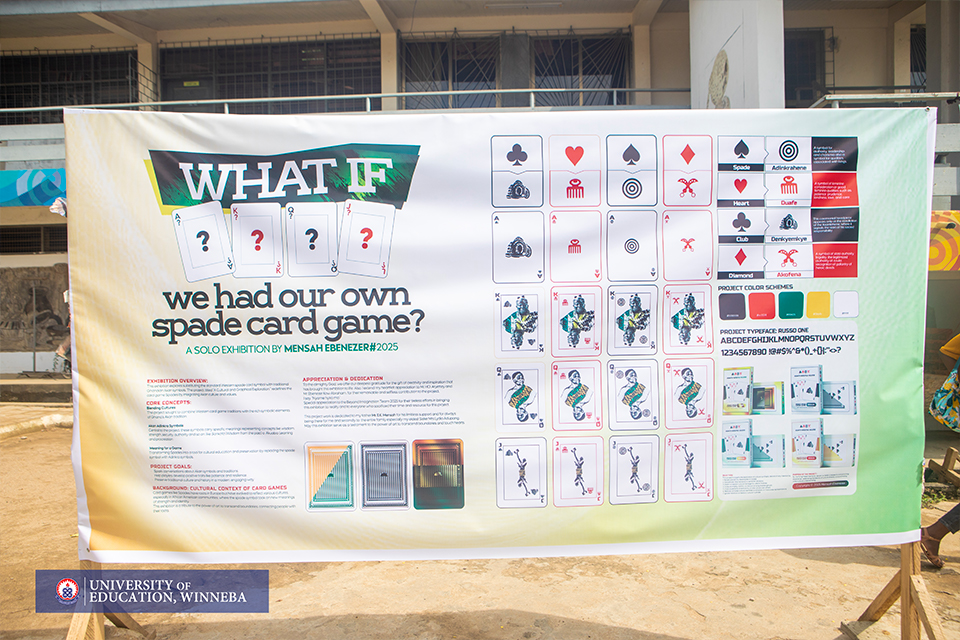
As guests toured the display of redesigned cards and explanatory panels, a shared theme emerged: Mensah’s work is more than a striking academic project; it is a bold step towards decolonising design and reclaiming Ghanaian identity in everyday leisure. By transforming an imported card game into a cultural classroom, the project exemplifies the University’s mission to blend scholarship with societal impact. For many present, it marked not an end but a beginning, a sign that UEW students are not only mastering their craft but reshaping the narratives of art, education and culture for a new generation.