Where Ideas Become Impact: UEW Marketing and Entrepreneurship Leads the Way


The Department of Marketing and Entrepreneurship at the University of Education, Winneba (UEW) is steadily emerging as a hub where ideas are nurtured, skills sharpened and future industry leaders shaped.
Driven by a philosophy that blends marketing excellence with entrepreneurial creativity, the Department has positioned itself as one of the most forward-looking academic departments within UEW’s School of Business. From curriculum design and assessment methods to student support systems and industry engagement, the department is redefining what it means to study marketing in Ghana’s competitive higher education landscape.
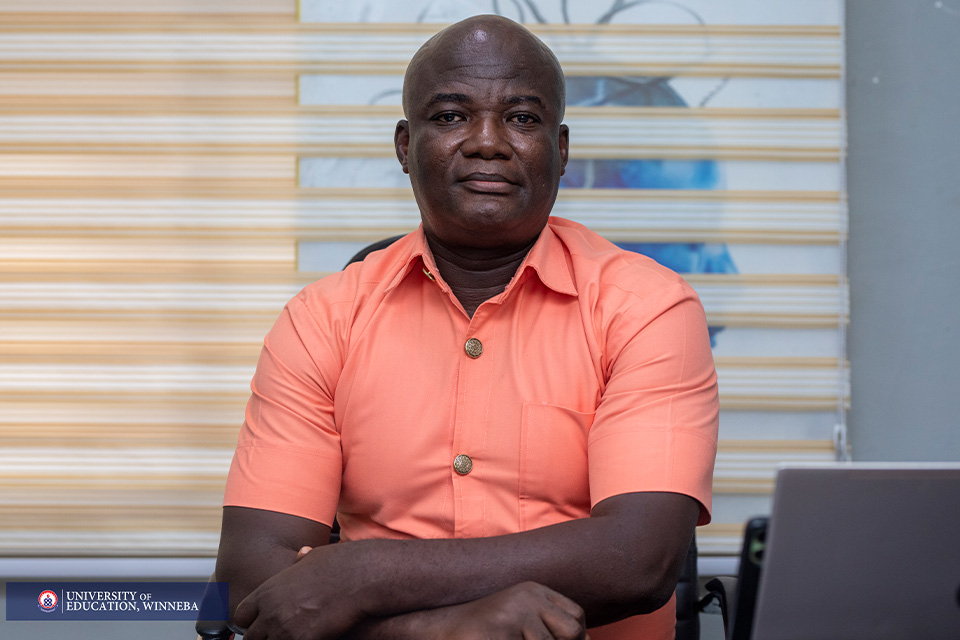
At the heart of the department’s progress is a clear vision articulated by its Head, Rev. Samuel Affran, who describes marketing not merely as buying and selling but as the science and art of creating and sustaining customers. Recognising that marketing, particularly service marketing, is best appreciated through experience, the department has invested in creating a welcoming, inspiring and functional learning environment that mirrors real-world business settings.
The Department's academic offerings reflect this commitment to experiential learning. At the undergraduate level, students pursue programmes such as BBA Marketing and BBA Marketing and Entrepreneurship while postgraduate students enrol in specialised programmes including MBA Marketing, MSc Applied Marketing and Entrepreneurial Management, MSc Entrepreneurial Management and Strategy, MA Political Marketing and Strategy and MPhil Entrepreneurship and Innovation Management. Notably, some of these programmes remain unique to UEW, giving graduates a competitive edge in the job market.
“Our goal is simple; when our graduates enter the market, they should be the first choice for employers, and when students think marketing and entrepreneurship, UEW should be their first choice,” Rev. Affran states.

At the postgraduate level, the department’s impact is further amplified through a highly structured yet flexible training system, according to Dr. Yaw Brew, Graduate Coordinator. Admission pathways are inclusive, accommodating candidates from diverse academic backgrounds while support mechanisms ensure that no student is left behind.
What truly distinguishes the department, however, is its emphasis on practical research, mentorship and innovation incubation from the very first semester. Students are guided to identify business or entrepreneurial problems early, develop solutions and refine them through seminars, industry interactions and supervised research.
Central to this process is the department’s Innovation Hub, a vibrant space many students describe as a “second home.” Here, ideas are transformed into viable products and services with some students successfully pitching to funding organisations and launching start-ups even before graduation.

The Department’s philosophy of practice-driven learning is also reflected in its assessment structure. Mr. Rexford Owusu Okyireh, Examination Officer, explains that evaluations are deliberately designed to balance theory with application. Continuous Assessment accounts for 40% while end-of-semester examinations make up 60%.
Practical assignments, presentations and hands-on activities form a significant part of the assessment process, ensuring that students graduate not only with strong academic records but also with industry-ready competencies. This approach also supports students with diverse learning strengths, reinforcing the department’s inclusive ethos.
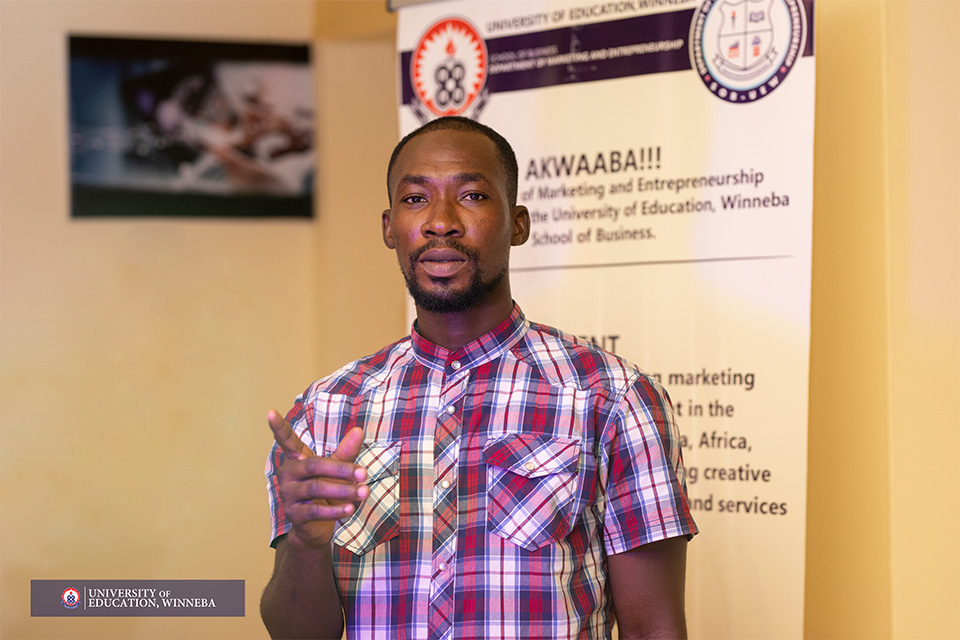
Behind the academic success is a responsive and student-centred administrative structure. Mr. Benjamin Kofi Essiaw, Senior Administrative Assistant, describes the department as one of the most active and student-friendly Departments within the School of Business. From academic coordination to student services, the administration works closely with faculty to ensure smooth programme delivery.
The Department also maintains strong industry partnerships, providing students with internship opportunities and real-life exposure to marketing practice. These collaborations further bridge the gap between theory and practice, reinforcing the department’s mission to cultivate job creators rather than job seekers.

For students, the Department represents more than an academic choice; it is a pathway to purpose. Ladylove Asare, a student leader, recounts how her understanding of marketing expanded beyond selling to encompass management, communication, accounting and innovation. She credits the programme for reshaping her mindset and dispelling myths about academic difficulty at UEW.

James Kpormegbe, Deputy PRO of the UEW Association of Business Students (UEWABS), describes the department as the environment where his entrepreneurial vision found structure and opportunity. Through practical training and leadership exposure, he has gained the confidence and skills to pursue his ambitions on a global scale.
Together, these perspectives paint a compelling picture of a department that is innovative, supportive and impact-driven. With its unique blend of marketing and entrepreneurship, strong faculty mentorship, practical orientation and student-centred culture, the Department of Marketing and Entrepreneurship at UEW continues to set the pace, preparing graduates not just for employment but for leadership and enterprise in a rapidly evolving world.
For prospective students seeking a place where ideas meet opportunity, UEW’s Department of Marketing and Entrepreneurship stands ready to welcome them.